
A delivery order (DO) is a document sent with goods to record what was delivered and to confirm that the customer received it. It normally shows the DO number, the delivery date, the customer’s details, a description of each item, the quantity, and the receiver’s signature.
It is your proof that the delivery actually happened — before any invoice is paid, and long after everyone has forgotten what was in the lorry. Below you can download a free Malaysian delivery order template in Excel, Word or PDF, see a completed example, and learn how to fill in every field.
Start where you need to
01. Download the free delivery order template
The standard delivery order — the one most businesses need — in five files. All free, all editable, no sign-up. The Excel version is a working spreadsheet, and both the Excel and Word files carry an English–Malay label sheet so one pad works for either kind of customer. If you deliver to several customers on one run, send goods out that have to come back, invoice for work rather than goods, or move chilled stock, section 02 has a sheet built for that instead.
Ten item rows, a live total-units formula, and a second sheet with the English–Malay labels.
Excel ↓If you would rather type than use a spreadsheet, or you need to restyle the header for your letterhead.
Word ↓For printing a pad and filling it in by hand at the warehouse. Page 2 is the bilingual label list.
PDF ↓The Kedai Runcit Seri Aman delivery from section 04, filled in and signed off.
Example ↓One page to print and stick near the loading area, so nothing leaves unsigned.
Checklist ↓Each template is set up for three copies — original for the customer, duplicate for your accounts, triplicate for the driver. Many Malaysian businesses work this way, and it is why a DO can settle an argument months later: three people held a copy. Your business may use fewer or more depending on how you work — adjust the template to suit.
Print tip: if you order a printed pad, ask for carbonless (NCR) paper in three colours. White for the customer, pink for accounts, yellow for the driver is the common set. Colour makes it obvious at a glance which copy went where.
02. Which delivery order do you need? Five formats
Most deliveries need the standard sheet above. But four situations break it, and each one has its own version below — same brand, same signature block, same bilingual labels, no prices on any of them.
| If this is your situation | Use | Because it adds |
|---|---|---|
| One customer, goods delivered and kept | Standard delivery order | The plain sheet — ten item rows and a signature block |
| One lorry, several customers on one run | Delivery sheet (multi-drop) | A line and a signature per drop, plus a run summary |
| Goods going out that should come back | Temporary delivery order | A reason, a return-by date, and a return record |
| You did work rather than delivered goods | Service delivery order | Work carried out, status, parts used, follow-up |
| Chilled, frozen or short-shelf-life stock | Perishables delivery order | Batch, expiry, temperature and a rejected-quantity line |
Not sure? Take the standard one. These are the same document with different fields, not different rules. Pick the sheet whose columns you would otherwise be scribbling into the margin.
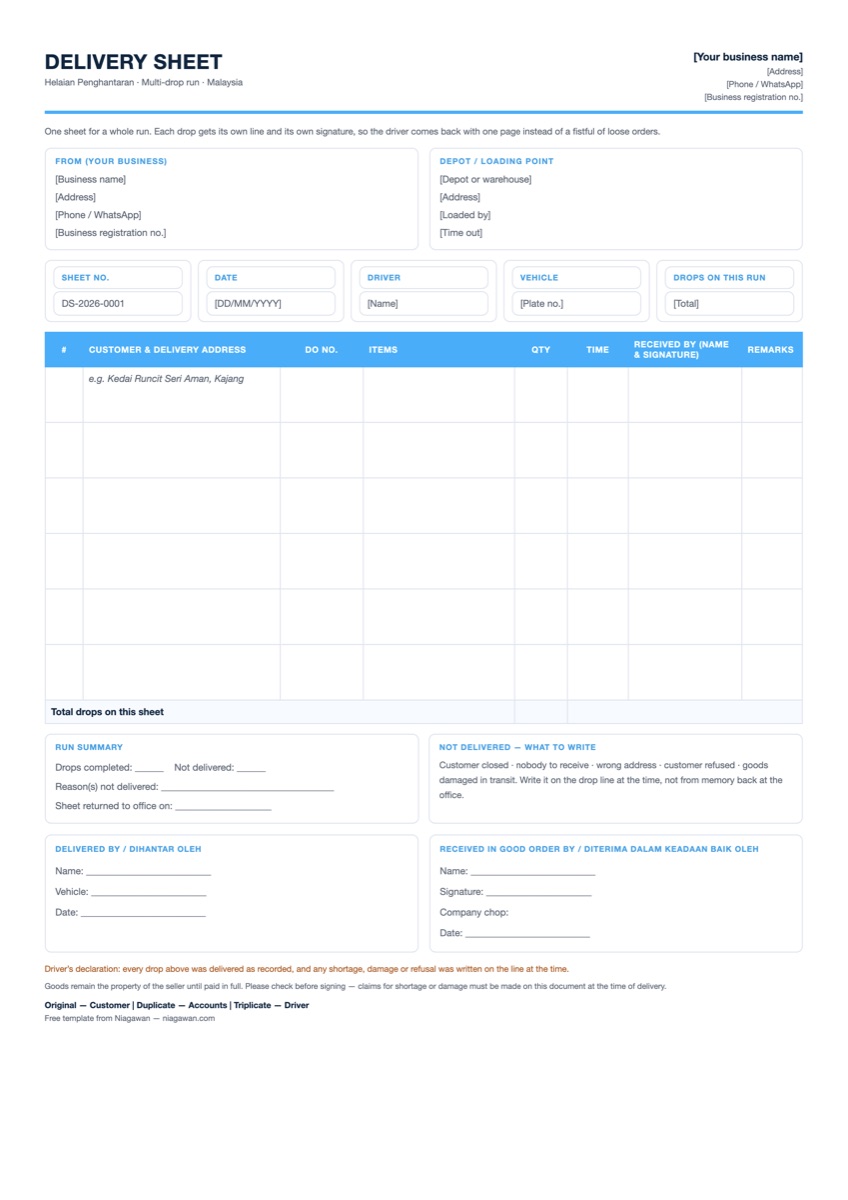
Delivery sheet — one run, several drops
Use it when: one vehicle leaves with goods for several customers and you do not want to hand the driver a loose pile of separate orders.
What it adds: a numbered line per drop with its own received-by signature and time, plus a run summary at the foot for drops completed, drops not delivered, and why.
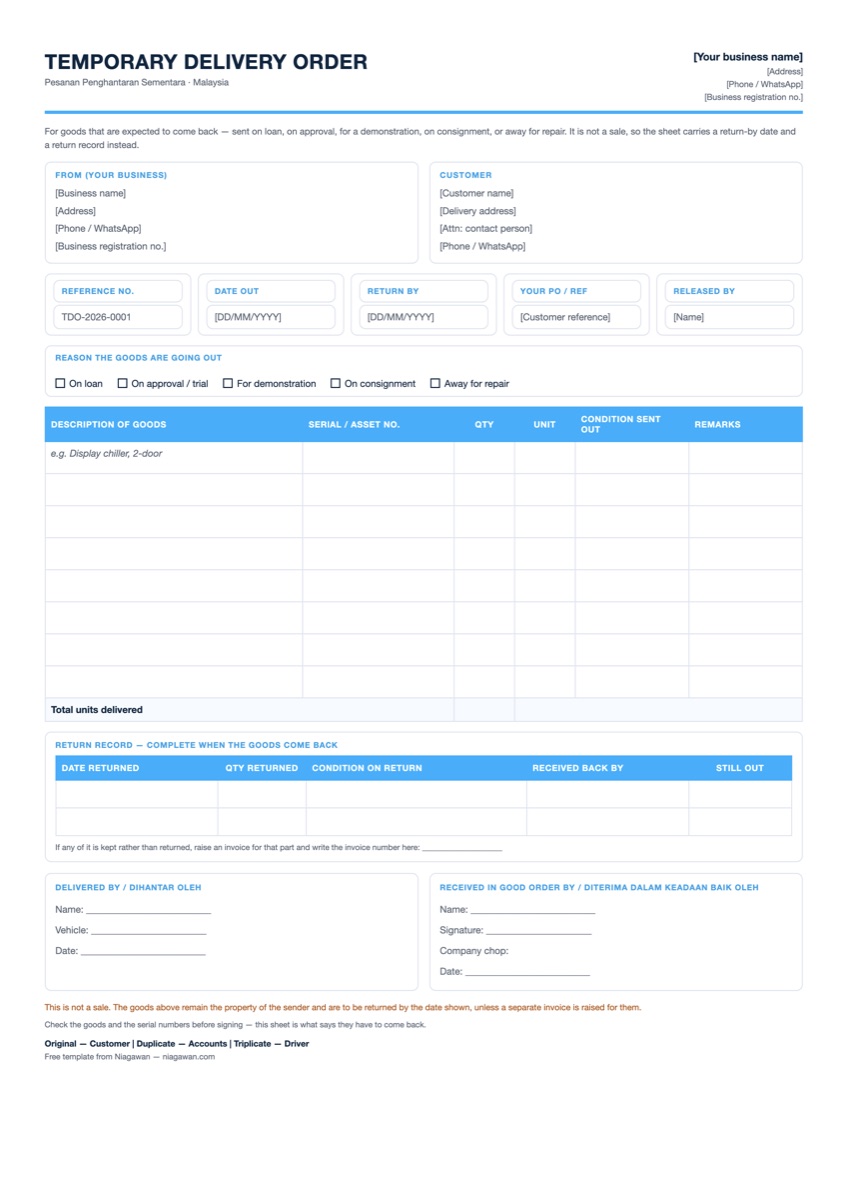
Temporary delivery order — goods that come back
Use it when: stock leaves on loan, on approval, for a demonstration, on consignment, or goes away for repair. It is not a sale, so a normal DO records the wrong thing.
What it adds: a tick-box for why the goods went out, a return-by date, a serial or asset number column, and a return record to complete when they come back — with a line for the invoice number if the customer keeps them.
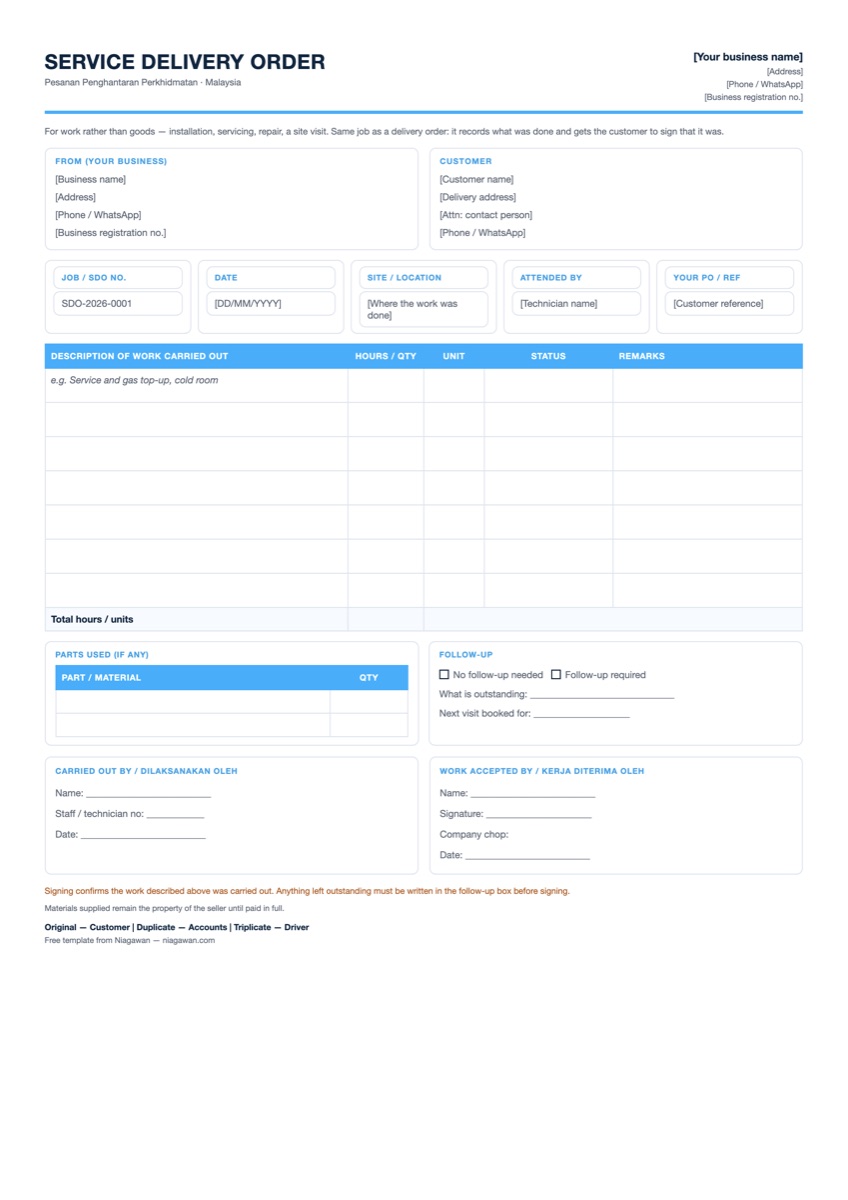
Service delivery order — work, not goods
Use it when: you install, service or repair something and need the customer to sign that the work was done.
What it adds: a work-carried-out table with a completed or partial status per line, a small parts-used table, and a follow-up box for anything left outstanding.
Perishables delivery order — chilled and F&B stock
Use it when: you deliver anything with an expiry date — fresh, chilled, frozen, bakery, dairy.
What it adds: batch or lot number, expiry date, temperature on arrival and condition per line, a cold-chain block for vehicle temperature at loading and delivery, and a rejected-quantity line so anything sent back goes back on the same trip.
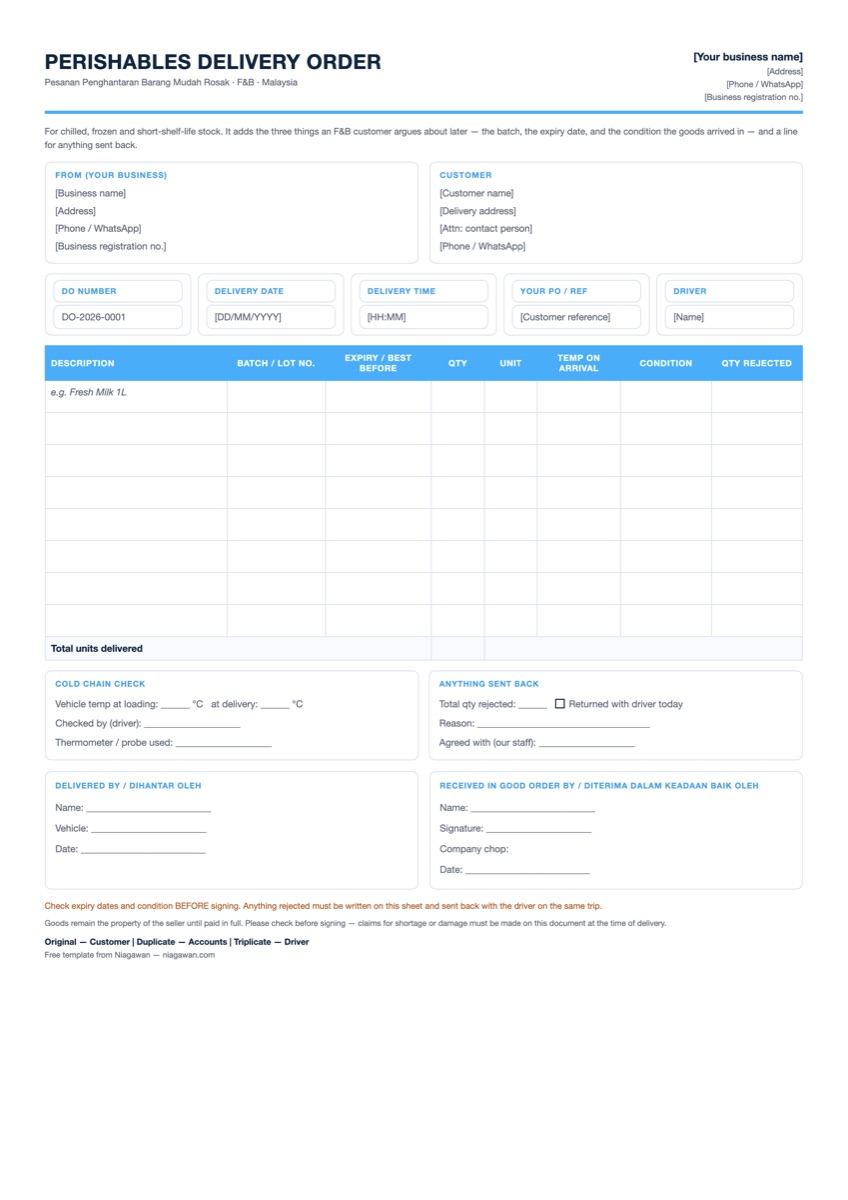
All four are laid out the same way as the standard sheet, so a customer who already signs your DO will not have to learn a new form. Every file is A4, prints to one page, and carries the three-copy footer.
03. The 60-second delivery order cheat sheet
You need a delivery order when goods physically move to a customer and the invoice is not travelling with them. That is nearly every business that delivers.
| Situation | Do you need a DO? |
|---|---|
| You deliver goods and invoice later (monthly, or on terms) | Yes. This is exactly what a DO is for. |
| Goods go out in stages against one big order | Yes — one DO per drop, so each delivery is signed for separately. |
| Customer collects from your shop and pays on the spot | No. The receipt or cash sale invoice already proves it. |
| You deliver and hand over the invoice at the same time | Optional — many still issue one, so there is a signature on delivery. |
| You are a service business with nothing physical to deliver | No. There are no goods to sign for. |
| Goods go to your own second branch | Yes, internally — it proves stock left one place and arrived at another. |
The one-line test: if something leaves your premises and you would struggle to prove it arrived, you needed a delivery order.
04. Delivery order example (Malaysia)
Here is an example of a completed delivery order for a Malaysian wholesale business. The customer ordered 60 bags of rice, but only 40 were delivered, so the DO records the delivery as partial and shows the remaining balance still to come.
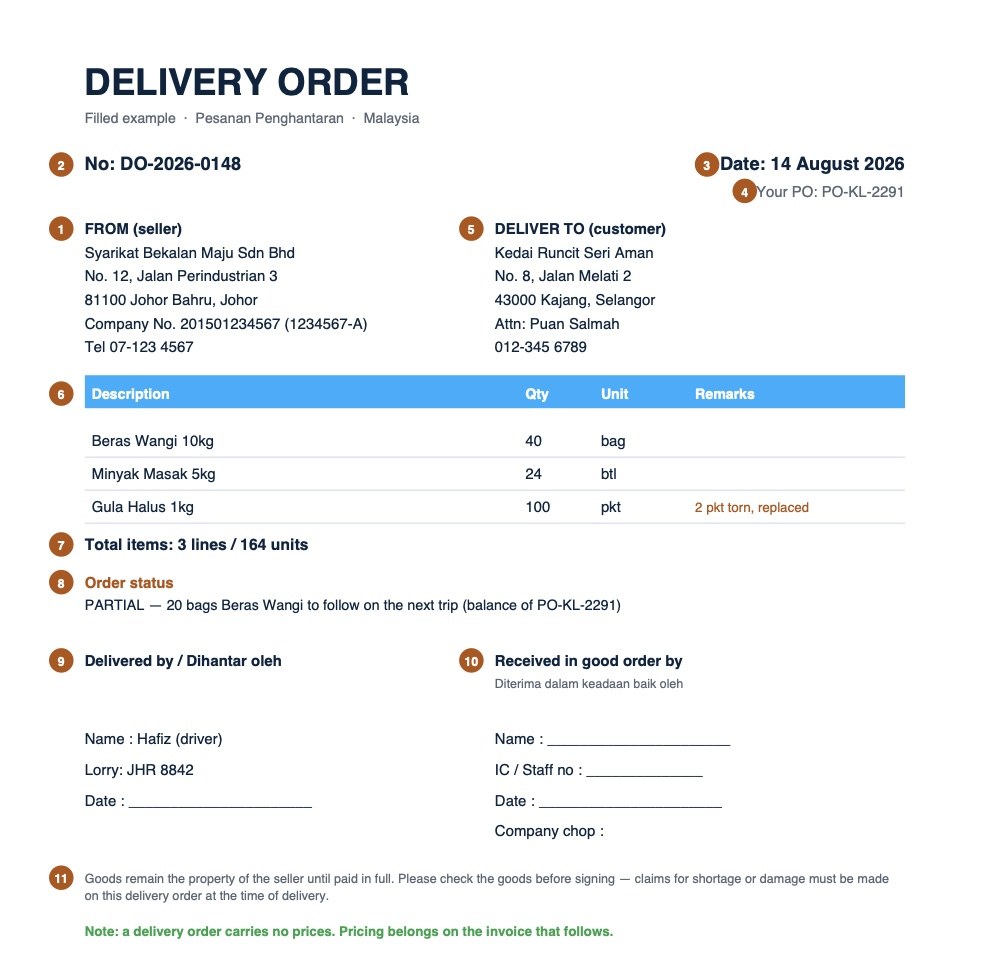
The same example is written out below as text, so you can copy any line straight into your own template.
| ❶ SYARIKAT BEKALAN MAJU SDN BHD No. 12, Jalan Perindustrian 3, 81100 Johor Bahru, Johor Company No. 201501234567 (1234567-A) · Tel 07-123 4567 | |
| DELIVERY ORDER (Pesanan Penghantaran) | ❷ DO No.: DO-2026-0148 ❸ Date: 14 August 2026 ❹ Your PO: PO-KL-2291 |
| ❺ Deliver to: Kedai Runcit Seri Aman No. 8, Jalan Melati 2, 43000 Kajang, Selangor Attn: Puan Salmah · 012-345 6789 | |
❻ Items delivered
| No. | Description | Qty | Unit | Remarks |
|---|---|---|---|---|
| 1 | Beras Wangi 10kg | 40 | bag | — |
| 2 | Minyak Masak 5kg | 24 | btl | — |
| 3 | Gula Halus 1kg | 100 | pkt | 2 pkt torn, replaced |
❼ Total items: 3 lines / 164 units
❽ Order status: PARTIAL — 20 bags Beras Wangi to follow on the next trip (balance of PO-KL-2291)
| ❾ Delivered by | ❿ Received in good order by |
|---|---|
| Name: Hafiz (driver) Lorry: JHR 8842 Date: 14/08/2026 |
Name: ______________ IC/Staff no: _________ Date: ______________ Company chop: |
➀ Goods remain the property of Syarikat Bekalan Maju Sdn Bhd until paid in full. Please check goods before signing — claims for shortage or damage must be made on this DO at the time of delivery.
Original — Customer | Duplicate — Accounts | Triplicate — Driver
Notice what is not on it: prices. A delivery order says what arrived, not what it costs. Keeping money off the DO is deliberate — the driver does not need to know your margins, and the customer’s storekeeper only has to check quantities against what is in front of them. Pricing belongs on the invoice.
On the SST line: a delivery order is generally used to record the movement and receipt of goods rather than to bill the customer, so this example carries no SST line. SST, where it applies, is normally reflected on the invoice or tax document that follows. Whether you must charge SST at all, and at what rate, depends on your registration and the goods involved — the Royal Malaysian Customs Department (RMCD) is the authority on that, not your template.
05. How to fill in a delivery order: every field explained
| # | Field | What it does | What goes wrong without it |
|---|---|---|---|
| ❶ | Your company details + registration number | Identifies who delivered (your SSM registration number) | A DO with no letterhead proves nothing about who sent it |
| ❷ | DO number | The unique reference for this delivery | You cannot match the delivery to an invoice later |
| ❸ | Delivery date | When the goods actually arrived | Payment terms have no start point |
| ❹ | Customer’s PO number | Ties the delivery to what they ordered | Their accounts department rejects the invoice |
| ❺ | Deliver-to address + contact | Where it goes, and who to call | The driver phones you instead of the customer |
| ❻ | Item lines: description, quantity, unit | What is being handed over | Any dispute becomes your word against theirs |
| ❼ | Total line and unit count | A quick check at the tailgate | Short deliveries slip through unnoticed |
| ❽ | Order status (full or partial) | Flags a balance still owing | The rest of the order is quietly forgotten |
| ❾ | Delivered by — driver name and vehicle | Who physically brought it | No one to ask when something is missing |
| ❿ | Received by — name, signature, chop, date | The whole point of the document | You have no proof of delivery at all |
| ➀ | Title and claims wording | Sets when ownership passes and how long to complain | Late claims for damage you cannot disprove |
The three fields people actually skip
The customer’s PO number (❹). It feels like admin until the day their accounts department holds your invoice because nothing links it to an approved order. One field, written at the point of delivery, prevents that entirely. If your customer sent you a purchase order, its number belongs here.
The order status (❽). Partial deliveries are where money leaks. A DO that says “PARTIAL — 20 bags to follow” is a note to both sides that the job is not finished. A DO that stays silent lets a short delivery become permanent.
The receiver’s chop (❿). A scribbled signature with no printed name and no company chop is close to worthless in a dispute — nobody can say who signed. Ask for a name in block letters next to the signature. It takes five seconds and it is the difference between proof and a squiggle.
06. Why bother? The RM3,000 delivery nobody can prove
A wholesaler delivers RM3,000 of stock to a shop on a Tuesday. The driver is in a hurry, nobody signs, and the DO comes back blank.
Six weeks later the invoice is unpaid. The shop owner says two of the cartons never arrived. The wholesaler is certain they did. There is no signature, no name, no chop, no date — only two people remembering a Tuesday differently.
There is no way to win that argument. In practice the wholesaler writes off part of the invoice to keep the customer, and the RM3,000 becomes maybe RM2,400.
A signed delivery order is a receipt for goods. It costs one piece of paper and thirty seconds at the tailgate, and it converts “I’m sure we delivered it” into something you can put in front of someone. That is the entire business case.
What we commonly see with Malaysian SMEs
The problem is rarely that a business forgets to issue a delivery order. It is that the signed copy never makes it back to the office. The driver delivers the goods, the customer signs, and the document then lives in the lorry, in a jacket pocket, or in a pile at the warehouse. Weeks later a quantity is queried and the accounts team cannot produce the one piece of paper that would settle it.
The businesses that avoid this treat the returned copy as part of the delivery run, not as paperwork: the driver hands the signed copies in at the end of the day, and someone checks the count of DOs out against DOs back. It is a two-minute habit that protects the whole month of invoicing.
The same document quietly does three other jobs:
- It starts the clock on payment terms. “30 days” from when? From the delivery date on the DO.
- It keeps your stock records honest. Goods left the warehouse on a date, against a document. Your stock count and your paperwork agree. If you are still counting stock by memory, inventory management is the wider fix.
- It tells your accounts what to invoice. A pile of signed DOs is a to-do list of invoices waiting to be raised.
07. Purchase order, delivery order, invoice — the document flow
These three documents get mixed up constantly. They are simply three different moments in the same transaction.
“Please send us 60 bags of rice.” Written by the buyer. Shows prices.
“Here are 40 bags. Sign here. 20 to follow.” Written by the seller. No prices.
“40 bags delivered on 14 Aug. RM1,600 due in 30 days.” Written by the seller. Shows prices.
| Purchase order | Delivery order | Invoice | |
|---|---|---|---|
| Who writes it | The buyer | The seller | The seller |
| When | Before anything moves | As the goods move | After delivery |
| Shows prices? | Yes | No | Yes |
| Signed by | Whoever approves spending | Whoever receives the goods | Nobody |
| Answers | “What did we agree to buy?” | “Did it actually arrive?” | “What do we owe?” |
The DO is usually the only one of the three that proves a physical event. A PO is a promise and an invoice is a claim — the delivery order is the one carrying a signature from someone who was standing there. Businesses vary, and some hand over the invoice with the goods; the sequence above is the common pattern rather than a rule.
When the invoice stage comes round, what a Malaysian invoice must show is a different set of rules again. And if you send prices before an order is confirmed, that is a proforma invoice — see also proforma invoice vs invoice.
08. Delivery order vs delivery note — are they the same?
In everyday Malaysian business use: yes. “Delivery order”, “DO”, “delivery note” and “despatch note” all describe the same piece of paper travelling with the goods to be signed on arrival.
The small distinction some businesses draw:
- Delivery order — leans towards an instruction to release and deliver goods, and is the term used almost everywhere in Malaysia.
- Delivery note — leans towards a simple list of what is in the box, and is the more common phrase in British usage.
If a customer asks for a “delivery note”, send them your delivery order. Nobody will object. Use whichever term your customers use — the fields that matter are identical either way.
09. “Delivery order” can mean something different in shipping
In freight and shipping, a delivery order (often written D/O) can also refer to a document issued by a shipping line, airline or freight forwarder that authorises the release of imported cargo from a port, depot or warehouse. That is a different document from the commercial delivery order template on this page.
If that is what you came for, your freight forwarder or shipping line issues it — a template will not help. If you deliver goods to your own customers, keep reading.
10. Delivery order terms in Malay
Malaysian businesses run in two languages, often on the same document. If your customer’s paperwork is in Malay, or you want a bilingual pad, here are the terms.
| English | Malay |
|---|---|
| Delivery order | Pesanan Penghantaran |
| Delivery order number | Nombor pesanan penghantaran |
| Date | Tarikh |
| Deliver to | Hantar kepada |
| Description of goods | Keterangan barang |
| Quantity | Kuantiti |
| Unit | Unit |
| Remarks | Catatan |
| Delivered by | Dihantar oleh |
| Received in good order by | Diterima dalam keadaan baik oleh |
| Signature | Tandatangan |
| Company chop | Cop syarikat |
| Partial delivery | Penghantaran sebahagian |
| Balance to follow | Baki akan menyusul |
| Goods remain our property until paid | Barang kekal milik kami sehingga dijelaskan |
The Excel and Word templates above carry these Malay labels on a second sheet, so one pad works for both kinds of customer.
Reading in Malay? The full walkthrough is here: Delivery Order (Pesanan Penghantaran): Cara Buat.
11. Five delivery order mistakes that cost real money
These are the ones that turn into arguments, unpaid invoices and stock that cannot be accounted for.
| The mistake | What it costs you |
|---|---|
| 1. No customer PO number on the DO | Nothing links the delivery to the order they approved, so their accounts department can hold your invoice. |
| 2. Quantity copied from the order instead of counted | The DO should show what physically left your premises. Copying the order hides short deliveries until the customer finds them. |
| 3. Partial delivery not recorded | The balance is quietly forgotten. Nobody chases the remaining items and nobody bills for them. |
| 4. Signature with no printed name | Months later nobody can say who signed, which makes the signature close to useless in a dispute. |
| 5. The signed copy never returns to the office | Your proof of delivery effectively disappears — see the box in section 06. This is the most common one. |
12. How to generate a delivery order in Niagawan
If you already record your sales in Niagawan, you do not need to retype anything. There are two ways to produce a DO.
From a sales invoice. Open the sales invoice for the order and generate the delivery order from it. The customer, the addresses and the item lines carry across, so the DO and the invoice agree with each other by construction — which is the point, since a mismatch between the two is what causes disputes in the first place.
Manually. Create the delivery order directly when there is no invoice yet — the common case when you deliver first and bill at the end of the month.
Either way the document is numbered, saved against the customer, and there when you need to find it six months later. Step-by-step screens for both routes are in the Malay walkthrough.
13. Before the lorry leaves: a signing checklist
Print this and keep it by the loading area. There is a one-page PDF version too.
Before the goods go out
- DO number filled in and recorded against the customer
- Customer’s PO number written on the DO
- Item descriptions match what is physically loaded — checked, not assumed
- Quantities counted at the tailgate, not copied from the order
- Partial delivery? The balance is written on the DO
- Three copies present and legible
At the point of delivery
- Receiver checks the goods before signing
- Signature plus printed name — a squiggle alone is not proof
- Company chop where the customer uses one
- Date written by the receiver
- Any shortage or damage noted on the DO itself, at the time
- Customer keeps the original; driver returns the other two copies
Back at the office
- Signed copy filed against the customer
- Stock records updated
- DO added to the list of deliveries waiting to be invoiced
Bryant Gan is the Founder of Niagawan — the cloud accounting and POS system used by more than 40,000 businesses in Malaysia since 2016. He has spent over 10 years building software that helps Malaysian SMEs keep their books, stock, and tax records in order.
14. Frequently asked questions
What is a delivery order?
A delivery order is a document a seller sends with goods, listing what is being delivered, which the customer signs on arrival to confirm receipt. It proves the delivery happened. It does not show prices — the invoice does that.
Can I get a free delivery order template?
Yes — every template on this page is free, with no sign-up. The standard delivery order comes in Excel, Word and PDF, and there are four more versions in Excel and PDF for multi-drop runs, goods sent out temporarily, service work, and perishables. There is also a completed example and a one-page signing checklist you can print.
Is a delivery order the same as an invoice?
No. A delivery order lists what was delivered and is signed by the person who received it. An invoice lists what is owed and asks for payment. The DO usually comes first; the invoice follows and refers back to it.
Does a delivery order need to show prices?
No, and most do not. Keeping prices off the DO means the driver and the customer’s storekeeper only deal with quantities. Pricing belongs on the invoice.
Is a delivery order the same as a tax invoice?
No. A delivery order is a commercial document — businesses use it because it is the practical proof that goods arrived, not because it satisfies a tax rule. A tax invoice is a separate document with its own requirements, and RMCD is the authority on those.
Is a delivery order the same as a delivery note?
In everyday Malaysian business use, yes. “Delivery order”, “DO”, “delivery note” and “despatch note” describe the same document. Use whichever term your customers use — the fields that matter are identical.
How many copies of a delivery order should I make?
Many Malaysian businesses use three: original for the customer, duplicate for accounts, triplicate for the driver. Fewer or more is fine — it depends on your workflow.
What happens if the customer refuses to sign?
Note the refusal and the reason on the DO, and have the driver sign that note. An unsigned DO with a written explanation and a driver’s signature is far stronger than a blank one.
Can one delivery order cover a partial delivery?
Yes, and it should say so. Mark it partial and write what is still to come, so both sides know the order is not finished.
What should a delivery order include?
Your company details and registration number, a unique DO number and delivery date, the customer’s PO number, the deliver-to address and contact, one line per item with description, quantity and unit, a total line, the full-or-partial status, the driver’s name and vehicle, and a received-by block with name, signature, company chop and date.
Is there a delivery order template in Excel?
Yes — every version on this page has an .xlsx file. The standard one has ten item rows, a live total-units formula, and a second sheet listing the English and Malay labels so you can print a bilingual pad. The multi-drop, temporary, service and perishables sheets are built the same way, with the columns each of those jobs needs.
What is a delivery order in shipping?
A different document entirely. In freight, a delivery order (D/O) is issued by a shipping line, airline or freight forwarder and authorises release of imported cargo from a port or depot to a named party. Section 09 explains the difference.
What is delivery order in Malay?
A delivery order in Malay is a pesanan penghantaran. Section 10 has the full English and Malay terminology table, and the templates carry those labels on a second sheet.
What is a temporary delivery order?
A delivery order for goods that are expected to come back — sent on loan, on approval, for a demonstration, on consignment, or away for repair. Because it is not a sale, it carries a return-by date, a serial or asset number for each item, and a return record to fill in when the goods come back. If the customer decides to keep them, you raise an invoice and note the invoice number on the sheet.
What is a delivery sheet?
A single sheet covering one vehicle run to several customers, instead of a separate delivery order per stop. Each drop gets its own numbered line with the customer, the quantity, the time and its own received-by signature, and the foot of the sheet records how many drops were completed and why any were not. Some businesses call it a run sheet or a courier sheet.
Do I need a different delivery order for chilled or frozen goods?
Not strictly, but the standard sheet leaves out the three things an F&B customer queries afterwards: the batch or lot number, the expiry date, and the condition the goods arrived in. The perishables version on this page adds those as columns, along with a vehicle temperature check and a rejected-quantity line so anything refused goes back with the driver on the same trip.
Who signs a delivery order?
The person receiving the goods signs it, and the driver signs the delivered-by side. Ask the receiver for a printed name and a company chop next to the signature — a signature alone often cannot be traced to anyone later.